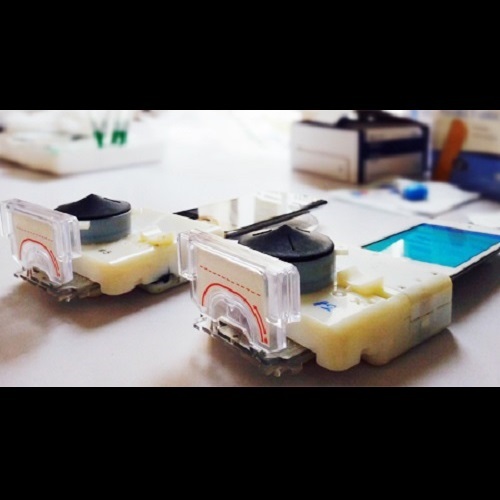
 A team of researchers has developed a low-cost smartphone accessory that can perform a "point-of-care" test that simultaneously detects three infectious disease markers from a finger prick of blood in just 15 minutes.
The device performs an enzyme-linked immunosorbent assay (ELISA) without requiring any stored energy: all necessary power is drawn from the smartphone. It performs a triplexed immunoassay not currently available in a single test format: HIV antibody, treponemal-specific antibody for syphilis, and non-treponemal antibody for active syphilis infection.
Samuel K. Sia, associate professor of biomedical engineering at Columbia Engineering, said that their work shows that a full laboratory-quality immunoassay can be run on a smartphone accessory and coupling microfluidics with recent advances in consumer electronics can make certain lab-based diagnostics accessible to almost any population with access to smartphones. This kind of capability can transform how health care services are delivered around the world.
Sia estimates the dongle will have a manufacturing cost of 34 dollars, much lower than the 18,450 dollars that typical ELISA equipment runs.
The team made two main innovations to the dongle to achieve low power consumption, a must in places that do not always have electricity 24/7. They eliminated the power-consuming electrical pump by using a "one-push vacuum", where a user mechanically activates a negative-pressure chamber to move a sequence of reagents pre-stored on a cassette.
The process is durable, requires little user training, and needs no maintenance or additional manufacturing. Sia's team was able to implement a second innovation to remove the need for a battery by using the audio jack for transmitting power and for data transmission. And, because audio jacks are standardized among smartphones, the dongle can be attached to any compatible smart device (including iPhones and Android phones) in a plug-and-play manner.
The work is published February 4 in Science Translational Medicine.

